Water purifier: the short answer
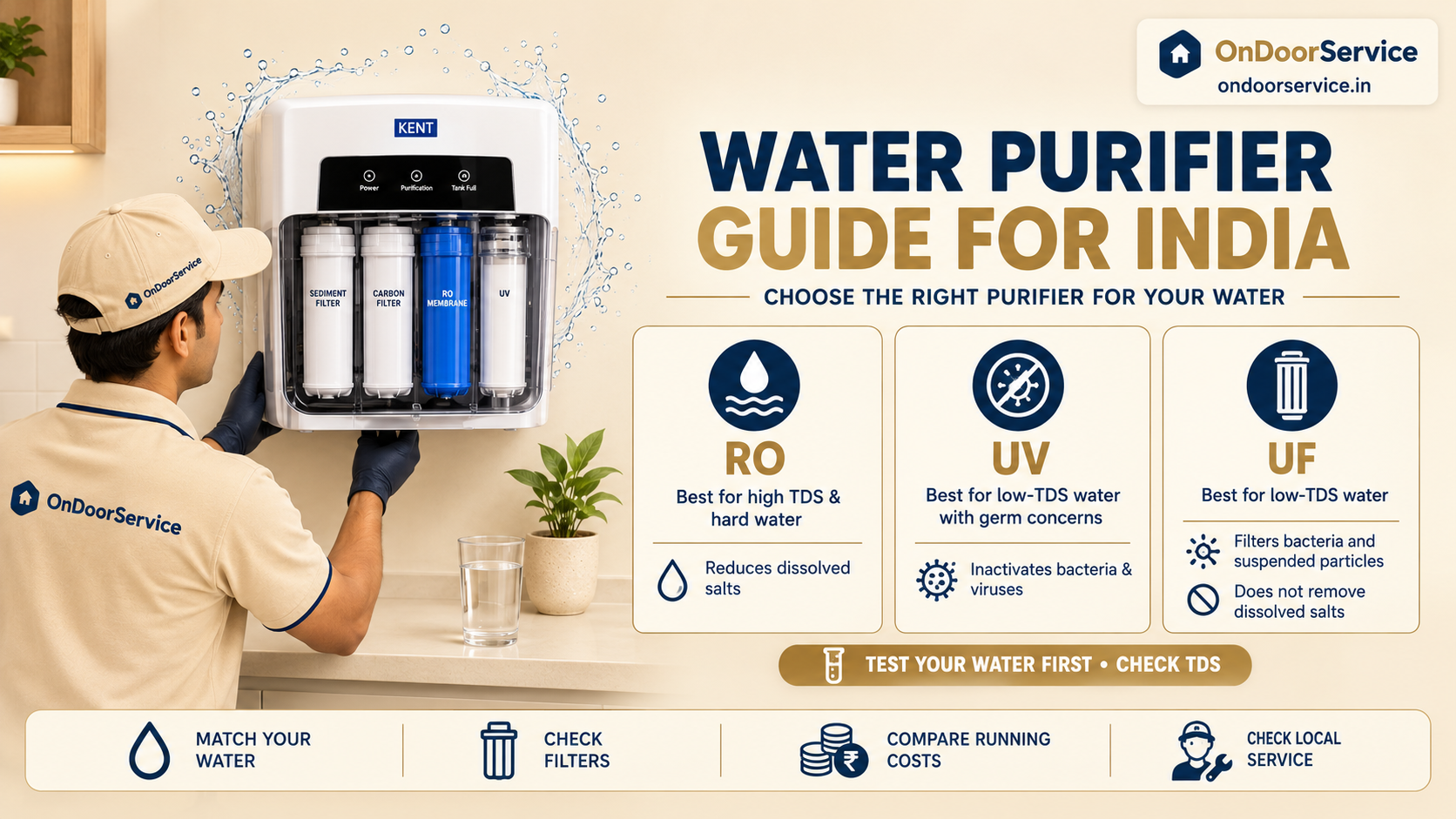
A water purifier makes tap, borewell or municipal water safe to drink. The right type depends on your water. Choose RO when dissolved salts (TDS) are high, and UV or UF when germs are the main worry.
- TDS above about 500 ppm: choose RO, or RO with UV.
- TDS below about 200 ppm and a clean source: UV or UF is usually enough.
- Not sure: test your TDS first. A handheld TDS meter takes a minute.
This guide explains how each purifier works, what its filters and parts do, how to choose one, and what it costs to run. It is written by the team that services RO purifiers in 50+ cities across India, so it also covers servicing and running costs, which many buying guides leave out.
What a water purifier is and how RO works
An RO (reverse osmosis) purifier is a very common type in Indian homes because it reduces dissolved salts, and many models add a UV or UF stage for germs. It pushes water under pressure through a very fine membrane. Water passes through, while most dissolved salts, metals and other contaminants are left behind and sent to the drain.
Most RO purifiers treat water in stages:
- Sediment filter: catches sand, silt and rust particles.
- Carbon filter: removes chlorine, odour and some chemicals.
- RO membrane: removes most dissolved salts. An RO booster pump supplies the pressure it needs.
- UV or UF stage (in many models): deals with bacteria and viruses that may get through.
- Mineral cartridge (in some models): adds back minerals and improves taste.
- Storage tank and tap: holds treated water for use.
RO needs electricity, because the pump and the UV lamp run on power. It also sends part of the incoming water to the drain. How much depends on the model and your incoming TDS, so check the reject-water figure before you buy.
RO is not always necessary. If your water is low in TDS, a UV or UF purifier avoids the water waste.
Types of water purifiers: RO, UV, UF and gravity
There are four main technologies. Many purifiers combine two or three of them, which is why you see labels like RO+UV+UF.
| Type | What it does | What it does not do | Needs power | Best for |
|---|---|---|---|---|
| RO | Removes most dissolved salts and metals; add UV or UF for germ protection | Wastes some water; can strip minerals | Yes | Borewell or hard water, high TDS |
| UV | Inactivates bacteria and viruses | Does not remove dissolved salts or dirt | Yes | Clean, low-TDS municipal water |
| UF | Filters out bacteria, cysts and suspended particles | Does not remove dissolved salts | Often no | Low-TDS water, areas with power cuts |
| Gravity (carbon or ceramic) | Basic filtering of particles and some chemicals | Limited on germs and dissolved salts | No | Backup, travel, very clean water |
Combination models, such as an RO UV water purifier (also written RO+UV) or an RO+UV+UF unit, add extra germ protection after the RO stage. They suit water of uncertain quality, such as tanker or mixed supply. For a full side-by-side, read our guide to RO vs UV vs UF.
Add-ons you will see on the label:
- TDS controller: mixes a little untreated water back in to keep minerals. It helps only when incoming TDS is moderate.
- Alkaline or ionizer: raises the pH of the water. It does not replace purification, and health claims for alkaline water are still debated.
- Copper: water stored in a copper stage. It is not a substitute for RO or UV.
- Hot and cold: adds a heater and chiller. It uses more power and has more parts that can fail.
Portable and travel purifiers use gravity or small filters. They are handy for trips and as a backup, but they do not replace a full home system.
Know your water first: TDS and hardness
TDS (total dissolved solids) is the quickest way to match a purifier to your water. It is measured in ppm, or mg/L, with a handheld meter. The Bureau of Indian Standards (IS 10500:2012) gives 500 mg/L as the acceptable limit for drinking water, and up to 2,000 mg/L where no better source exists.
WHO has not set a health-based guideline value for TDS. Its background document on TDS rates taste instead: under 300 mg/L is excellent, 300 to 600 good, 600 to 900 fair, 900 to 1,200 poor, and above 1,200 unacceptable. It also notes that water with extremely low TDS can taste flat.
| Your TDS reading | Typical choice |
|---|---|
| Below about 200 ppm | UV or UF; RO is usually not needed |
| About 200 to 500 ppm | RO with a TDS controller, or RO+UV, depending on taste and hardness |
| Above 500 ppm | RO or RO+UV; check membrane capacity |
Treat these bands as practical guidance, not a standard.
A TDS meter reads dissolved salts only, so it does not show bacteria, fluoride, arsenic or nitrate. If you suspect a specific contaminant, only a lab test can tell you.
Hard water leaves scale on kettles and inside purifiers. It is common with borewell supply and shortens the life of the membrane and heating parts. RO reduces hardness; UV and UF do not.
RO output can end up quite low in TDS. If you prefer a fuller taste, see how to remineralise RO water.
Inside a purifier: filters and parts, and when each needs changing
Most purifier problems trace back to a worn RO filter or a failed part. People often say "RO filter" for the whole set of stages, or for the cartridges inside it.
| Part | What it does | Signs it needs attention | Typical interval |
|---|---|---|---|
| Sediment filter | Catches sand, silt and rust | Slow flow, cloudy water | Every 3 to 6 months |
| Carbon filter | Removes chlorine, odour and some chemicals | Chlorine smell, bad taste | Every 6 to 12 months |
| RO membrane | Removes dissolved salts | Output TDS rising, very slow or low output | Every 2 to 3 years, sooner with hard water |
| UV lamp | Inactivates bacteria and viruses | Indicator light off, lamp not glowing | About once a year (8,000 to 10,000 hours) |
| RO booster pump | Gives the membrane the pressure it needs | Loud noise, low flow, no water | When it fails |
| SMPS adapter | Converts mains power for the pump and valves | Purifier dead or restarting | When it fails |
| Mineral cartridge | Adds back minerals and improves taste | Flat taste after RO | Every 6 to 12 months |
Intervals vary by brand, how much water you use and your incoming TDS. Hard or high-TDS water wears filters out faster.
The membrane is the costly part, and it fails quietly: the water still looks clear while the TDS creeps up. A TDS meter reading of the output water is the simplest check. RO membrane price depends on its capacity (GPD rating), the brand and your purifier model, so ask for a quote and the part number before you agree.
The storage tank holds treated water, and its size sets how much you can draw at once. A tank that will not fill is often a pressure or membrane problem rather than a tank fault.
Use genuine parts. Cheap or mismatched parts, especially membranes and adapters, can damage the system or give poor output. Ask for the part name and the warranty before any replacement.
If a part has failed, a technician can usually confirm which one in a single visit. See our RO service page for what a visit covers.
How to choose the best water purifier for your home
Start with your water, then work through four checks. Brand and price come last.
- Match the technology to your TDS. Use the table above. Buying RO for low-TDS water wastes water and strips minerals. Buying UV alone for high-TDS water leaves the salts in.
- Check storage and flow. A family of four usually needs a tank of around 7 to 10 litres. Larger families or heavy use need more, or a higher flow rate.
- Check the reject-water figure. Ask how many litres go to the drain for each litre of purified water. Some homes reuse reject water for mopping or plants.
- Look at service support. A purifier is only as good as the nearest technician. Check that your city has service, that parts are available, and what the warranty covers.
Features worth paying for: a TDS controller if your TDS is moderate, a UV or UF stage if your supply is uncertain, and a clear filter-change indicator. Features to question: premium add-ons such as alkaline or copper stages, which do not replace purification.
What it costs to run
The purchase price is only part of the cost. Each year you also pay for filters, servicing and the occasional part. Here are OnDoorService's current RO service prices.
| Service | Price |
|---|---|
| Inspection and diagnosis | From ₹199 |
| Basic service (filter cleaning, membrane flush, TDS check, sanitisation) | ₹299 |
| Complete service (filter replacement, membrane cleaning, full sanitisation) | ₹599 |
| Full overhaul (membrane replacement, all filters, motor check) | ₹999+ |
| RO annual maintenance contract (AMC) | From ₹2,499 per year |
Parts are charged separately, based on what your purifier needs. Prices are as listed on our site and can change, so check the RO service page before you book.
When you compare models, add up five years: purchase price, filter and membrane changes, and servicing. A cheaper purifier with costly filters can end up more expensive than a mid-range one. The table below uses OnDoorService's approximate parts price list and change intervals. The low end assumes the longest interval and the lowest price, and the high end the reverse.
| What you pay for | Over 5 years (approx.) |
|---|---|
| Parts for a basic RO: sediment, carbon and post-carbon filters, and the membrane | ₹5,000 to ₹21,000 |
| Add a UV lamp and mineral cartridge, if your model has them | ₹8,500 to ₹31,000 |
| Annual maintenance contract at ₹2,499 a year | About ₹12,500 |
The purchase price and electricity are extra. An AMC may already include some filter changes, so check what it covers before adding both together.
Home purifier or RO plant?
A home purifier suits one household. An RO plant suits a business, a society or any place that needs a lot of drinking water.
RO plants are rated in litres per hour (LPH). Common sizes are 50, 100, 250, 500, 1,000 and 2,000 LPH. They use larger membranes and pumps, need a bigger tank and more space, and are built to run for hours at a time.
A plant makes sense when:
- you run an office, clinic, school, factory or water-refill business
- one purifier cannot keep up with the demand
- you want to supply drinking water to several flats or buildings
For a normal home, a standard purifier is the better choice. A small plant for a large house is possible, but it costs more to install, needs space and has higher running costs.
Plant prices depend on capacity, the number of membranes, the tank and installation. Ask for a written quote that lists each item, and check who will service the plant after installation.
Servicing, AMC and common problems
A purifier needs regular care. Service it every 3 to 6 months, or sooner if your water is hard or high in TDS. Skipping service can lead to falling water quality and costlier repairs. Our guide on how often to service your RO explains the schedule in detail.
An annual maintenance contract (AMC) bundles scheduled visits and filter changes into one yearly fee. It suits homes that do not want to track filter dates. Check what it covers and what it leaves out before you sign. Details are on our RO AMC page.
Installation affects performance from day one: it covers pressure, wall mounting, drain and power. See RO installation.
Most faults fall into a handful of types. The table shows the usual causes listed in our service guides, and the guides below explain each fix:
| Symptom | Usual causes | First check |
|---|---|---|
| No water or very slow flow | Clogged pre-filters, low inlet pressure, failed booster pump, damaged membrane | Check the inlet valve and supply pressure; replace pre-filters |
| Output TDS higher than normal | Worn membrane, TDS controller set too high | Test the output with a TDS meter; adjust the controller |
| Bad taste or smell | Exhausted post-carbon filter, bacteria in the tank | Replace the post-carbon filter; sanitise the tank |
| Blinking or dead indicator light | Faulty SMPS adapter, filter-change alert, PCB fault | Try another socket; check the adapter |
| UV light not working | Lamp burnout, dirty or cracked quartz sleeve | Check whether the lamp glows; replace the lamp |
| Rotten-egg smell | Bacteria in the tank or tubing, hydrogen sulphide in borewell water | Drain, flush and sanitise; consider a UV or UF stage for borewell water |
- Common RO problems, causes and solutions
- RO water flow slow
- RO leaking water
- RO tank not filling up
- RO purifier noise problem
- When to replace an RO system
If the problem continues after basic checks, book a visit. OnDoorService technicians service RO purifiers of all major brands, with a 30-day warranty on labour and up to 90 days on genuine parts. Start at our RO service page.
Frequently asked questions
Which water purifier is best for a home in India?
There is no single best model. Choose by your water: RO or RO+UV for high-TDS borewell or hard water, and UV or UF for low-TDS municipal water. Then check storage size, reject water and local service support.
Is RO water safe to drink every day?
Yes, RO water is safe to drink. It removes most dissolved salts, which can leave it low in minerals. If you prefer a fuller taste, use a model with a TDS controller or a mineral cartridge, and keep eating a balanced diet.
What TDS is good for drinking water?
The BIS acceptable limit is 500 mg/L. Many people find water in the range of roughly 50 to 150 ppm pleasant after RO, but that is a taste preference, not a standard. WHO has set no health-based limit for TDS, only a taste scale. TDS also says nothing about germs or specific chemicals.
Does an RO purifier waste water?
Yes. Part of the incoming water goes to the drain, and the amount depends on the model and your incoming TDS. Check the reject-water figure before buying, and reuse the reject water for cleaning where you can.
How often should I service my RO purifier?
Every 3 to 6 months. Sediment filters usually need changing every 3 to 6 months, carbon filters every 6 to 12 months, and the membrane every 2 to 3 years. Hard or high-TDS water shortens these intervals.
Is RO or UV better for borewell water?
RO is the better choice for most borewell water because it reduces dissolved salts and hardness. UV only treats germs. For uncertain supply, RO+UV adds an extra germ-protection stage.
Can a water purifier work without electricity?
Gravity-based purifiers and some UF models work without power. RO and UV purifiers need electricity for the pump and lamp.
Next step
Test your TDS, match the technology to your water, and service the purifier every 3 to 6 months. If you need help choosing, installing or servicing one, call 8586965458 or book on our RO service page.
Published and last updated: 21 October 2026. Prices and part costs are taken from our own price lists as of that date and can change. Questions about this guide: info@ondoorservice.in.