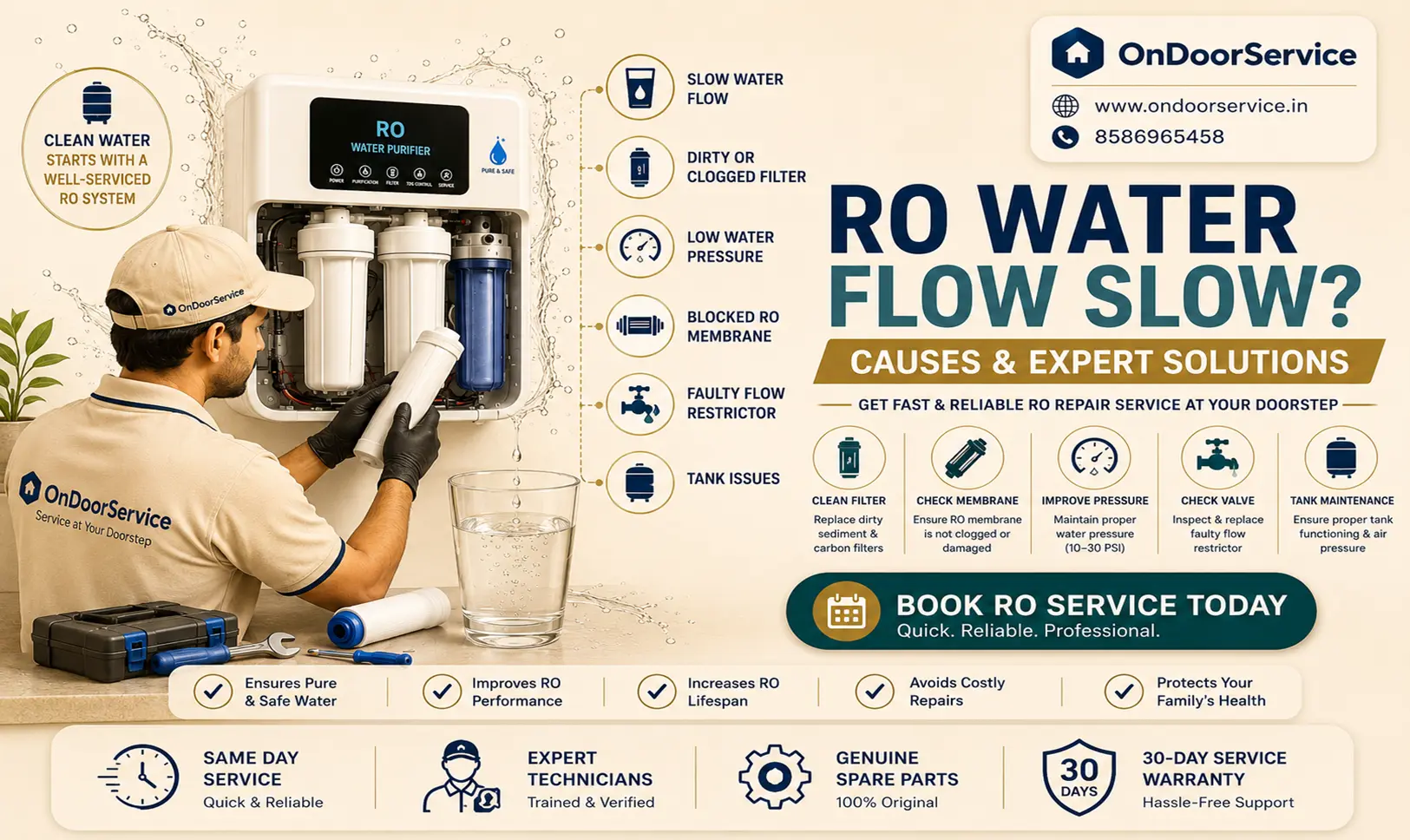
Is your RO water flow slow, taking several minutes to fill a glass, or producing much less water than usual? While reverse osmosis systems naturally dispense water more slowly than a regular tap, a sudden drop in water flow often indicates a maintenance issue that should not be ignored. Common causes include clogged filters, a worn-out RO membrane, low tank pressure, insufficient inlet water pressure, blocked tubing, or a faulty storage tank.
This comprehensive guide explains why your RO water flow is slow, how to identify the exact cause, practical troubleshooting steps you can perform at home, and when it is better to call a professional technician. You'll also learn preventive maintenance tips that can improve your purifier's performance and extend its lifespan.
If your purifier is producing very little water, leaking, or overdue for maintenance, you can book a professional RO service near you for a complete inspection, filter replacement, and system servicing.
Quick Answer: Why Is Your RO Water Flow Slow?
In most cases, slow RO water flow is caused by clogged sediment or carbon filters, a blocked RO membrane, low air pressure inside the storage tank, insufficient inlet water pressure, kinked tubing, or worn-out internal components. Replacing filters on time, maintaining the correct tank pressure, and servicing the purifier every 6–12 months usually restores normal water flow.
Quick Solution: If your RO purifier suddenly starts dispensing water slowly, first check whether the filters need replacement, inspect the storage tank pressure (7–8 PSI when empty), ensure the inlet water pressure is at least 40 PSI, and examine all tubing for bends or blockages. These simple checks solve most slow-flow problems.
Signs Your RO Water Purifier Has Slow Water Flow
A gradual reduction in water flow often goes unnoticed until the purifier becomes difficult to use. Recognizing the early warning signs can help prevent expensive repairs and maintain consistent drinking water quality.
- Water comes out as a thin stream instead of a steady flow.
- The storage tank takes much longer than usual to fill.
- Only one or two glasses of water are available before the pressure drops.
- The purifier runs continuously without producing enough water.
- The RO pump runs more frequently than before.
- Water pressure suddenly decreases after replacing filters.
- The taste of drinking water begins to change.
- The TDS level gradually increases.
If you notice any of these symptoms, don't ignore them. A simple filter replacement or pressure adjustment today can prevent expensive membrane or tank replacement later.
How Does an RO Water Purifier Produce Water?
Understanding how a reverse osmosis purifier works makes troubleshooting much easier. Water first passes through sediment and carbon filters, where larger particles, chlorine, and organic contaminants are removed. The partially filtered water then reaches the RO membrane, which removes dissolved salts, heavy metals, and many other impurities through a semi-permeable membrane.
After purification, the clean water is stored in a pressure tank until you open the faucet. The compressed air inside the storage tank pushes purified water to the tap. If any stage of this process is restricted, water flow becomes noticeably slower.
Because reverse osmosis filters water molecule by molecule, these systems naturally produce water at a slower rate than conventional taps. However, if your purifier suddenly becomes much slower than normal, it usually indicates a component that requires maintenance or replacement.
If your purifier has not been serviced within the last year, scheduling routine maintenance can prevent many common performance issues. Homeowners looking for doorstep maintenance can book RO Service in Bilaspur for complete filter inspection, membrane testing, and preventive servicing.
What Causes Slow RO Water Flow?
Several factors can reduce the amount of purified water your reverse osmosis system produces. Some issues are simple to fix at home, while others require replacement parts or professional servicing.
The most common causes include:
- Clogged sediment or carbon filters.
- A blocked or worn-out RO membrane.
- Low air pressure inside the storage tank.
- A damaged pressure tank bladder.
- Low incoming water pressure.
- Kinked or blocked tubing.
- A faulty automatic shut-off valve.
- High TDS in the source water.
- Cold water temperatures reducing membrane efficiency.
- Poor maintenance or overdue servicing.
In the following sections, we'll examine each of these problems in detail, explain how to diagnose them accurately, and provide step-by-step solutions to restore your RO system's performance.
1. Clogged RO Membrane
A clogged RO membrane is one of the leading reasons for RO water flow slow problems. The membrane is responsible for removing dissolved salts, heavy metals, and microscopic contaminants from water. Over time, minerals such as calcium and magnesium, along with sediment and other impurities, accumulate on the membrane surface. This buildup restricts water flow and reduces the purifier's overall efficiency.
Most RO membranes last between 2 and 3 years, depending on the quality of the incoming water, daily usage, and how well the pre-filters are maintained. If pre-filters are not replaced on time, the membrane clogs much faster.
Signs of a Clogged RO Membrane
- Water flow has gradually become slower.
- The storage tank takes more than 4 hours to fill.
- Higher TDS in purified water.
- Unpleasant taste despite recent servicing.
- The purifier runs continuously without filling the tank.
How to Fix It
- Check the membrane's age.
- Replace the membrane if it is older than 24–36 months.
- Replace sediment and carbon filters at the same time.
- Flush the RO system after installing a new membrane.
If your purifier has an old membrane and clogged filters, replacing both together usually restores normal water production. Our technicians provide complete RO Service in Bilaspur including membrane replacement, TDS testing, and full system inspection.
2. Dirty Sediment and Carbon Filters
Sediment and carbon filters protect the RO membrane by removing dust, sand, rust, chlorine, and other contaminants before water reaches the membrane. As these filters become dirty, they restrict water flow, forcing the purifier to work harder while producing less purified water.
This is the most common reason homeowners experience slow RO water flow, especially if the purifier has not been serviced for more than six months.
Symptoms
- Reduced water pressure from the RO faucet.
- Slow tank filling.
- Bad taste or odor in drinking water.
- Higher load on the RO membrane.
Recommended Replacement Schedule
| Filter | Recommended Replacement |
|---|---|
| Sediment Filter | Every 6–12 months |
| Carbon Filter | Every 6–12 months |
| Post Carbon Filter | Every 12 months |
| RO Membrane | Every 24–36 months |
Following the recommended replacement schedule not only improves water flow but also increases the lifespan of the RO membrane.
Need filter replacement? Book RO Service in Muzaffarpur or RO Service in Jorhat for genuine filter replacement and complete RO maintenance.
3. Low Air Pressure Inside the RO Storage Tank
The storage tank contains an internal air bladder that pushes purified water to the faucet. If the air pressure drops below the recommended level, water may trickle slowly even though the tank contains water.
For most domestic RO systems, the ideal air pressure inside an empty storage tank is between 7 and 8 PSI.
Common Symptoms
- Normal flow for a few seconds, then water slows dramatically.
- The tank feels heavy but delivers very little water.
- Low pressure only from the RO faucet.
Solution
- Turn off the water supply.
- Completely empty the storage tank.
- Measure the air pressure using a pressure gauge.
- Add air until it reaches 7–8 PSI.
- Reconnect the system and allow the tank to refill.
Avoid overinflating the tank, as excessive pressure can reduce storage capacity and damage the internal bladder.
4. Damaged Pressure Tank Bladder
If adjusting the tank pressure doesn't solve the issue, the internal rubber bladder may have ruptured. A damaged bladder cannot hold pressure, preventing the tank from storing and dispensing water correctly.
Signs of a Faulty Tank Bladder
- The tank feels full but very little water comes out.
- Pressure drops immediately after opening the faucet.
- The tank never fills completely.
- Water production remains slow after replacing filters.
Solution
Unfortunately, a damaged bladder cannot be repaired. The most effective solution is to replace the entire RO storage tank with a compatible model.
Professional technicians can also check the automatic shut-off valve and tank pressure before recommending replacement. Customers can schedule RO Service in Rourkela for complete storage tank diagnosis and repair.
5. Low Incoming Water Pressure
Reverse osmosis systems rely on adequate inlet water pressure to force water through the membrane. If your home's water pressure is too low, the purifier will produce water very slowly regardless of the condition of its filters.
Most RO systems require a minimum inlet pressure of 40 PSI, while 60 PSI is considered ideal for efficient operation.
How to Identify Low Water Pressure
- Multiple taps in the house have weak water flow.
- The RO system takes several hours to fill the tank.
- Water production slows during peak usage hours.
- The purifier performs better late at night when municipal pressure increases.
Solutions
- Check your home's water pressure with a pressure gauge.
- Ensure the inlet valve is fully open.
- Install an RO booster pump if pressure remains below 40 PSI.
- Contact your local water supplier if municipal pressure is consistently low.
If low pressure has affected your purifier for a long time, it's advisable to inspect the membrane and filters as well. Homeowners can book RO Service in Agra or RO Service in Durgapur for water pressure testing and complete RO health checks.
6. Kinked or Blocked RO Tubing
The water travels through several food-grade plastic tubes inside your reverse osmosis purifier. If one of these tubes becomes bent, pinched, clogged, or improperly installed, water flow can decrease significantly. This problem often occurs after relocating the purifier or replacing filters.
Common Signs
- Water flow suddenly becomes slow after servicing.
- Visible bends or twists in the tubing.
- Water leaks around push-fit connectors.
- Reduced pressure from the RO faucet.
How to Fix It
- Inspect every water tube from the inlet to the faucet.
- Straighten any kinked tubing.
- Replace damaged or cracked pipes.
- Ensure quick-connect fittings are fully locked.
If your purifier still has low water flow after checking the tubing, professional diagnosis can identify hidden restrictions. Our technicians provide RO Service in Agartala for complete water flow inspection and tubing replacement.
7. Faulty Automatic Shut-Off (ASO) Valve
The Automatic Shut-Off (ASO) valve controls water entering the RO membrane. When it becomes blocked or fails internally, the purifier may produce water very slowly or stop filling the storage tank completely.
Symptoms
- Tank never fills completely.
- Continuous drain water.
- Purifier runs constantly.
- Very low water production.
Solution
Inspect the ASO valve for blockage or damage. In most cases, replacing the valve is more effective than attempting repairs.
8. High TDS in Source Water
Areas with high Total Dissolved Solids (TDS) place additional stress on the RO membrane. The higher the mineral concentration, the harder the membrane works, which naturally reduces water production.
If your source water has a TDS level above 800–1000 ppm, filter replacement intervals may become shorter than the manufacturer's recommendation.
How to Reduce the Impact
- Monitor TDS regularly using a digital meter.
- Replace filters on schedule.
- Flush the membrane periodically.
- Install a booster pump if pressure is also low.
If your locality has consistently high TDS, regular servicing is essential. Customers can schedule RO Service in Korba or RO Service in Purnia for TDS testing and complete RO maintenance.
9. Cold Water Temperature
Many homeowners don't realize that water temperature affects reverse osmosis performance. During winter, colder water becomes more viscous, making it harder for water molecules to pass through the RO membrane.
As a result, purified water production may decrease by 20–50% depending on the temperature.
This is normal and usually improves as the water temperature rises.
10. Poor RO Maintenance
Ignoring routine maintenance is one of the biggest reasons why RO systems gradually become slower. Filters become clogged, membranes lose efficiency, tubing accumulates deposits, and pressure problems go unnoticed.
A well-maintained purifier consistently delivers better water quality, improved pressure, lower electricity consumption, and longer component life.
If your purifier hasn't been serviced within the last 6–12 months, it's a good time to schedule professional maintenance. Our experts also provide RO Service in Sitamarhi, RO Service in Gaya, and RO Service in Tirupati for complete system servicing.
Step-by-Step RO Water Flow Troubleshooting Guide
Before replacing expensive components, follow these troubleshooting steps to identify the actual cause of slow water flow.
- Check whether the storage tank is full.
- Inspect the sediment and carbon filters.
- Measure the incoming water pressure.
- Check tank air pressure (7–8 PSI when empty).
- Inspect all tubing for bends or leaks.
- Test the purified water TDS.
- Inspect the RO membrane if it is older than two years.
- Check the ASO valve and flow restrictor.
- Look for continuous drain water.
- Schedule professional servicing if the problem continues.
Recommended RO Maintenance Schedule
| Component | Recommended Interval |
|---|---|
| Sediment Filter | Every 6–12 Months |
| Carbon Filter | Every 6–12 Months |
| Post Carbon Filter | Every 12 Months |
| RO Membrane | Every 24–36 Months |
| Complete RO Service | Every 6–12 Months |
| TDS Check | Monthly |
Tips to Prevent Slow RO Water Flow
- Replace filters before they become clogged.
- Replace the RO membrane every 2–3 years.
- Maintain tank pressure between 7 and 8 PSI.
- Keep inlet water pressure above 40 PSI.
- Check tubing regularly for leaks or bends.
- Use genuine replacement filters.
- Flush the purifier after replacing components.
- Schedule annual professional maintenance.
RO Service Cost in India
| Service | Estimated Cost |
|---|---|
| Basic RO Service | ₹300–₹700 |
| Filter Replacement | ₹500–₹2,000 |
| RO Membrane Replacement | ₹1,200–₹3,500 |
| Annual Maintenance Contract (AMC) | ₹2,000–₹6,000 |
Looking for reliable doorstep service? Our technicians also offer RO Service in Dibrugarh with filter replacement, membrane inspection, leakage repair, and complete preventive maintenance.
When Should You Call a Professional?
While many slow water flow issues can be resolved with basic maintenance, professional servicing is recommended if:
- The purifier has not been serviced for more than 12 months.
- The storage tank is not filling.
- Water leakage is visible.
- TDS remains high after replacing filters.
- The purifier produces almost no water.
- The RO membrane or pressure tank requires replacement.
- You notice unusual noises from the booster pump.
If you're looking for reliable doorstep servicing, our experienced technicians provide complete inspection, filter replacement, membrane replacement, leakage repair, TDS testing, and preventive maintenance. You can also explore our city-specific services, including RO Service in Jamshedpur, RO Service in Kanpur, RO Service in Muzaffarpur, RO Service in Bilaspur, RO Service in Agra, RO Service in Dibrugarh, and other service locations across India.
Related RO Troubleshooting Guides
If you're experiencing other problems with your water purifier, you may also find these guides helpful:
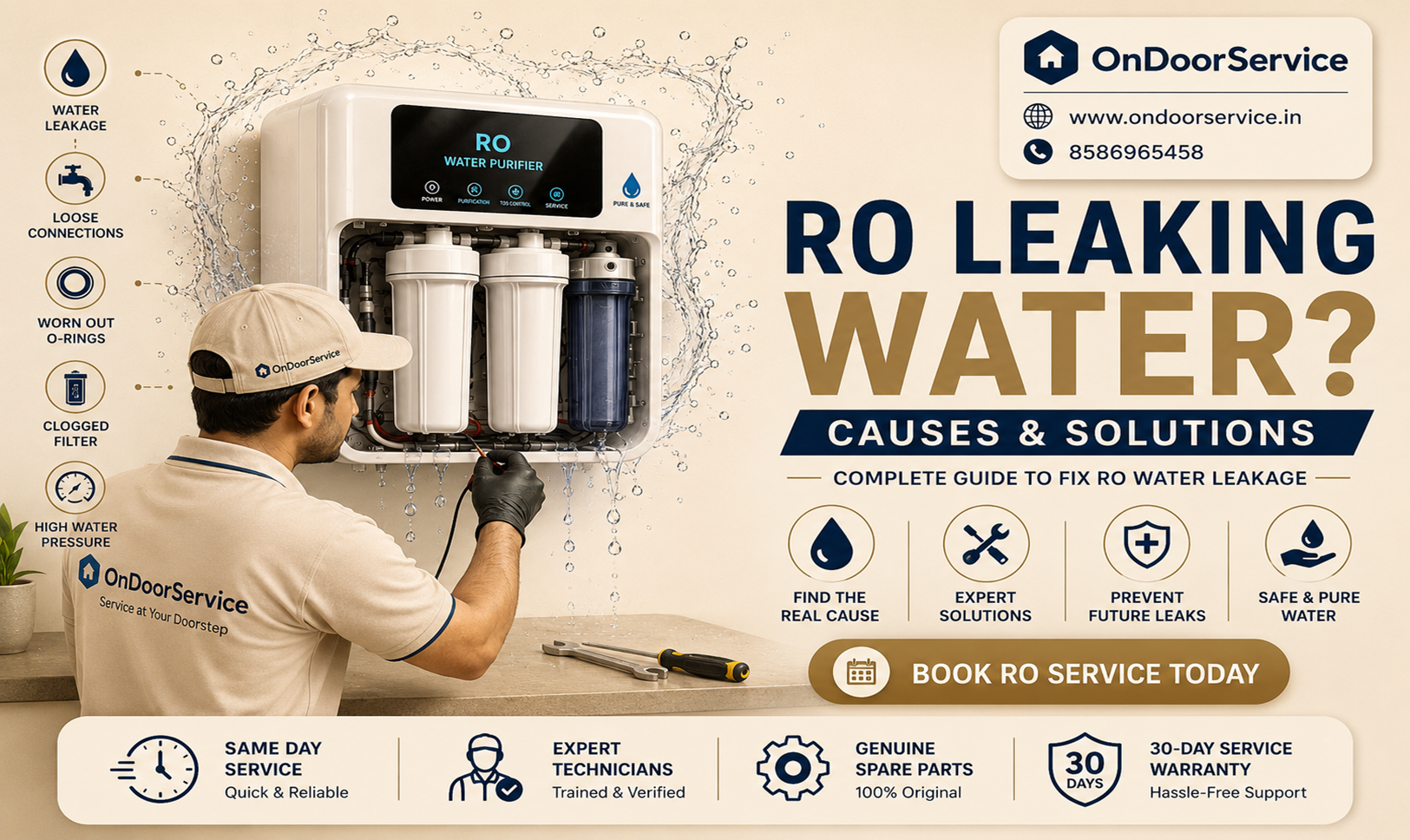
- RO Leaking Water – Common Causes and Solutions
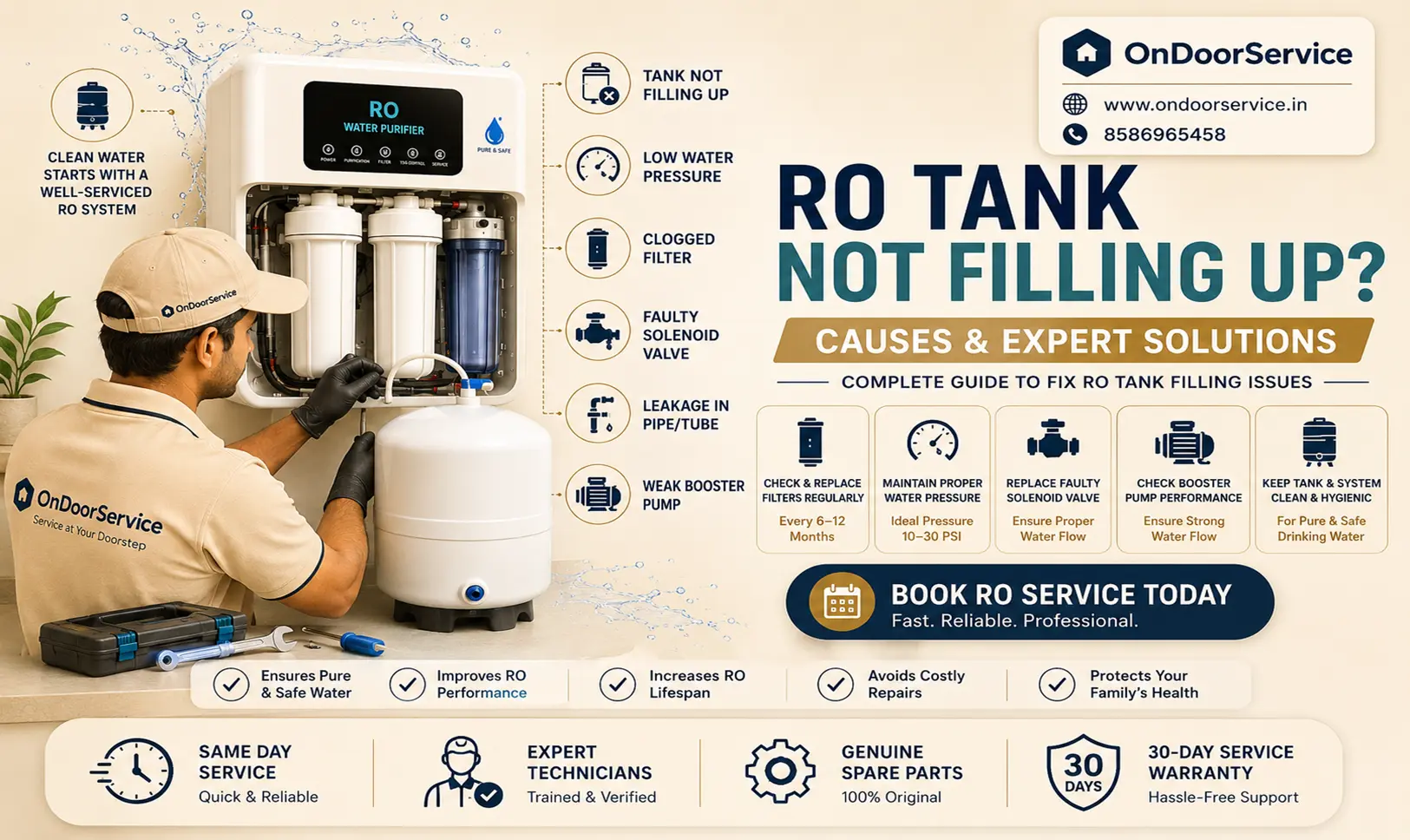
- RO Tank Not Filling Up – Causes and Fixes
- RO Service Frequency Guide
- How to Remineralize RO Water
- Common RO Problems and Their Solutions
Conclusion
Experiencing RO water flow slow problems is common, but most cases are caused by routine maintenance issues such as clogged filters, a worn-out membrane, low tank pressure, blocked tubing, or insufficient inlet water pressure. Identifying the exact cause early can prevent costly repairs and help maintain consistent water quality.
Following the recommended maintenance schedule, replacing filters on time, monitoring TDS levels, and scheduling professional servicing every 6–12 months will significantly improve the performance and lifespan of your reverse osmosis system.
If your RO purifier continues to produce very little water even after basic troubleshooting, booking a professional RO service near you is the safest way to restore normal performance and protect your investment.

Comments (0)
Leave a Comment