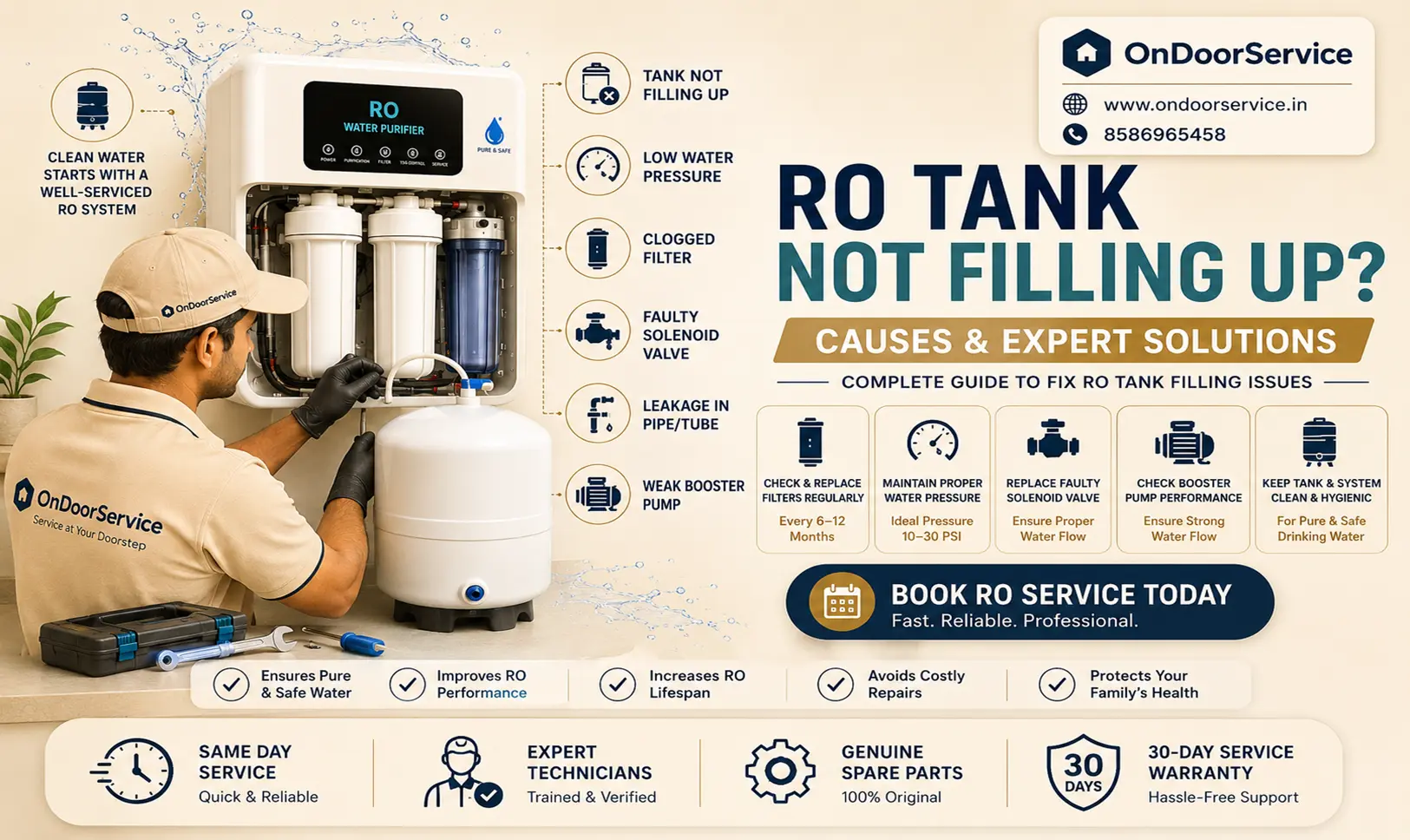
Is your RO tank not filling up or taking much longer than usual to produce purified water? A reverse osmosis (RO) system is designed to continuously filter water and store it inside the pressure tank for immediate use. If the storage tank remains empty or fills very slowly, it usually indicates a problem with the water pressure, filters, membrane, pressure tank, or other internal components.
Ignoring this issue can lead to poor water flow, higher TDS levels, unnecessary strain on the RO membrane, and expensive repairs. The good news is that most causes of a reverse osmosis tank not filling can be identified and resolved with timely maintenance and a few simple troubleshooting steps.
In this comprehensive guide, you'll learn why your RO tank is not filling, how to diagnose the problem, practical DIY fixes, when professional servicing is required, and preventive maintenance tips to keep your water purifier operating efficiently.
If your purifier has stopped producing enough water or the storage tank remains empty despite continuous operation, it's best to schedule a professional RO Service in Jamshedpur for a complete inspection before the issue causes permanent damage to the membrane or storage tank.
Signs Your RO Tank Is Not Filling Properly
Before replacing filters or dismantling your purifier, confirm that the storage tank is actually experiencing a filling problem. The following symptoms are commonly associated with an RO tank that is not filling correctly.
- The storage tank takes more than four to six hours to fill completely.
- Very little water comes from the RO faucet.
- The purifier runs continuously without storing enough water.
- The storage tank feels empty even after several hours.
- Water pressure drops immediately after filling a single glass.
- The purifier produces water much slower than before.
- The TDS level gradually starts increasing.
- The drain line runs continuously.
Any one of these warning signs may indicate clogged filters, insufficient inlet water pressure, a damaged RO membrane, or problems with the pressure tank. Early diagnosis helps avoid unnecessary replacement of expensive components.
Why Is Your RO Tank Not Filling Up?
Several components work together inside a reverse osmosis purifier. If even one of them stops functioning correctly, the purifier may struggle to produce enough purified water for the storage tank.
The four most common causes include:
- Low inlet water pressure.
- Clogged sediment or carbon filters.
- Faulty RO pressure tank or damaged bladder.
- Reduced RO membrane performance or low GPD capacity.
We'll examine each problem in detail, explain how to identify it, and show the most effective solution.
Is your RO tank not filling up or taking much longer than usual to produce purified water? A reverse osmosis (RO) system is designed to continuously filter water and store it inside the pressure tank for immediate use. If the storage tank remains empty or fills very slowly, it usually indicates a problem with the water pressure, filters, membrane, pressure tank, or other internal components.
Ignoring this issue can lead to poor water flow, higher TDS levels, unnecessary strain on the RO membrane, and expensive repairs. The good news is that most causes of a reverse osmosis tank not filling can be identified and resolved with timely maintenance and a few simple troubleshooting steps.
In this comprehensive guide, you'll learn why your RO tank is not filling, how to diagnose the problem, practical DIY fixes, when professional servicing is required, and preventive maintenance tips to keep your water purifier operating efficiently.
If your purifier has stopped producing enough water or the storage tank remains empty despite continuous operation, it's best to schedule a professional RO Service in Jamshedpur for a complete inspection before the issue causes permanent damage to the membrane or storage tank.
Signs Your RO Tank Is Not Filling Properly
Before replacing filters or dismantling your purifier, confirm that the storage tank is actually experiencing a filling problem. The following symptoms are commonly associated with an RO tank that is not filling correctly.
- The storage tank takes more than four to six hours to fill completely.
- Very little water comes from the RO faucet.
- The purifier runs continuously without storing enough water.
- The storage tank feels empty even after several hours.
- Water pressure drops immediately after filling a single glass.
- The purifier produces water much slower than before.
- The TDS level gradually starts increasing.
- The drain line runs continuously.
Any one of these warning signs may indicate clogged filters, insufficient inlet water pressure, a damaged RO membrane, or problems with the pressure tank. Early diagnosis helps avoid unnecessary replacement of expensive components.
Why Is Your RO Tank Not Filling Up?
Several components work together inside a reverse osmosis purifier. If even one of them stops functioning correctly, the purifier may struggle to produce enough purified water for the storage tank.
The four most common causes include:
- Low inlet water pressure.
- Clogged sediment or carbon filters.
- Faulty RO pressure tank or damaged bladder.
- Reduced RO membrane performance or low GPD capacity.
We'll examine each problem in detail, explain how to identify it, and show the most effective solution.
3. Faulty RO Pressure Tank or Damaged Bladder
If your filters are clean and the inlet water pressure is normal, the next component to inspect is the RO pressure tank. The storage tank contains an internal rubber bladder and a compressed air chamber that work together to store purified water and deliver it to the faucet. If the bladder becomes damaged or the air pressure drops below the recommended level, the tank may stop filling properly or deliver very little water.
A healthy RO pressure tank should have an air pressure of approximately 7–9 PSI when completely empty. Low air pressure reduces the tank's ability to store water, while a ruptured bladder usually requires complete tank replacement.
Symptoms of a Faulty RO Pressure Tank
- The storage tank feels heavy but very little water comes out.
- Only one or two glasses of water are available before the pressure drops.
- The tank never fills completely.
- The faucet produces weak water flow.
- The purifier continuously runs but stores very little water.
- Water pressure decreases immediately after opening the faucet.
How to Check the RO Tank Pressure
- Turn off the water supply.
- Empty the storage tank completely.
- Use a tire pressure gauge to measure the air pressure at the tank valve.
- If the reading is below 7 PSI, add air using a bicycle pump.
- If the pressure cannot be maintained, the internal bladder is likely damaged and the tank should be replaced.
Can You Repair an RO Pressure Tank?
If the problem is simply low air pressure, the tank can often be restored by adding air after draining all the stored water. However, if the internal bladder has ruptured or the tank leaks air continuously, replacing the storage tank is usually the safest and most cost-effective solution.
If you're unsure whether the pressure tank or membrane is causing the problem, you can schedule RO Service in Gaya for a complete inspection and pressure tank testing by experienced technicians.
4. RO Membrane Performance or Low GPD Capacity
The RO membrane is the heart of every reverse osmosis purifier. Its primary function is to remove dissolved salts, heavy metals, bacteria, viruses, and other contaminants from drinking water. As the membrane ages or becomes clogged with impurities, water production gradually decreases, making the storage tank take much longer to fill.
Another factor that affects tank filling speed is the membrane's production capacity, which is measured in Gallons Per Day (GPD). A lower-capacity membrane naturally produces purified water more slowly than a higher-capacity model.
Common RO Membrane Capacities
| Membrane Capacity | Suitable For | Water Production |
|---|---|---|
| 50 GPD | Small Families | Slow |
| 75 GPD | Average Homes | Moderate |
| 100 GPD | Large Families | Fast |
| 150 GPD | Heavy Daily Usage | Very Fast |
Signs the RO Membrane Needs Replacement
- High TDS reading.
- Slow water production.
- Tank takes several hours to fill.
- Bad taste in drinking water.
- Frequent filter replacements do not improve performance.
- The membrane is more than two to three years old.
How to Improve RO Water Production
- Replace the RO membrane if it has reached the end of its service life.
- Replace clogged sediment and carbon filters.
- Maintain inlet water pressure between 40 and 80 PSI.
- Flush the RO system regularly.
- Use genuine replacement parts for optimal performance.
If your purifier still produces very little water after replacing the filters, the membrane may require inspection or replacement. Our RO Service in Purnia team provides genuine membrane replacement, TDS testing, and complete RO system servicing at your doorstep.
How Long Should an RO Tank Take to Fill?
Under normal operating conditions, a standard household reverse osmosis storage tank typically fills within 2 to 4 hours. The exact filling time depends on several factors, including inlet water pressure, membrane capacity, filter condition, and water temperature.
| Condition | Expected Filling Time |
|---|---|
| New RO System | 2–4 Hours |
| Low Water Pressure | 5–8 Hours |
| Clogged Filters | 6+ Hours |
| Faulty Membrane | Very Slow or No Filling |
| Damaged Pressure Tank | Tank May Never Fill |
If your RO storage tank consistently takes longer than six hours to fill, professional diagnosis is recommended to prevent additional wear on the purifier.
We also provide doorstep RO Service in Dibrugarh and RO Service in Agra for slow water production, membrane replacement, pressure tank repair, and complete annual maintenance.
Step-by-Step Troubleshooting Checklist
If your RO tank is not filling up, don't replace expensive components immediately. Follow this troubleshooting checklist to identify the actual cause of the problem.
- Ensure the inlet water valve is fully open.
- Check whether your home's water pressure is between 40 and 80 PSI.
- Inspect sediment and carbon filters for clogging.
- Measure the TDS level of the purified water.
- Inspect the RO membrane if it is older than two to three years.
- Check the storage tank pressure (7–9 PSI when empty).
- Inspect all tubing and fittings for leaks or blockages.
- Flush the system after replacing any filters.
- Verify that the automatic shut-off valve is functioning correctly.
- Test the purifier again before replacing expensive parts.
Common RO Tank Problems and Their Solutions
| Problem | Possible Cause | Recommended Solution |
|---|---|---|
| Tank not filling | Low inlet water pressure | Install a booster pump or resolve plumbing issues. |
| Slow water production | Clogged sediment/carbon filters | Replace all pre-filters. |
| Very little water from faucet | Low tank air pressure | Recharge or replace the pressure tank. |
| High TDS reading | Old RO membrane | Replace the membrane. |
| Continuous drain water | Faulty shut-off valve | Inspect and replace the automatic shut-off valve. |
| Tank fills extremely slowly | Low GPD membrane | Upgrade to a higher-capacity membrane if appropriate. |
How to Prevent Your RO Tank from Filling Slowly
Most storage tank issues can be avoided through regular preventive maintenance. Following a proper servicing schedule keeps the purifier working efficiently and helps avoid costly repairs.
- Replace sediment filters every 3–6 months.
- Replace carbon filters every 6–12 months.
- Replace the RO membrane every 2–3 years.
- Flush the purifier regularly.
- Check the storage tank pressure every six months.
- Monitor the TDS level monthly.
- Use genuine replacement filters.
- Schedule professional servicing at least once a year.
Preventive maintenance is significantly more affordable than replacing damaged membranes, storage tanks, or booster pumps.
When Should You Call a Professional?
Although homeowners can resolve basic maintenance issues themselves, professional servicing is recommended when:
- The storage tank never fills.
- Water production remains slow after replacing filters.
- The purifier leaks water.
- The TDS remains unusually high.
- The booster pump stops working.
- The RO membrane requires replacement.
- The pressure tank loses air repeatedly.
- The purifier makes unusual noises.
Our experienced technicians provide doorstep RO installation, filter replacement, membrane replacement, leak repair, pressure testing, sanitization, and annual maintenance across multiple cities.
Book your nearest service today:
- RO Service in Muzaffarpur
- RO Service in Jorhat
- RO Service in Korba
- RO Service in Sitamarhi
- RO Service in Durgapur
- RO Service in Agartala
- RO Service in Tirupati
You can also visit our RO Service Near Me page to find professional water purifier repair and maintenance services in your city.
Conclusion
If your RO tank is not filling up, the issue is usually related to low water pressure, clogged filters, an aging RO membrane, a faulty pressure tank, or a malfunctioning shut-off valve. Identifying the root cause early prevents unnecessary part replacements and ensures your purifier continues delivering clean, safe drinking water.
Regular maintenance—including timely filter replacement, membrane inspection, pressure testing, and annual servicing—can significantly extend the lifespan of your RO system while maintaining optimal water quality.

Comments (0)
Leave a Comment