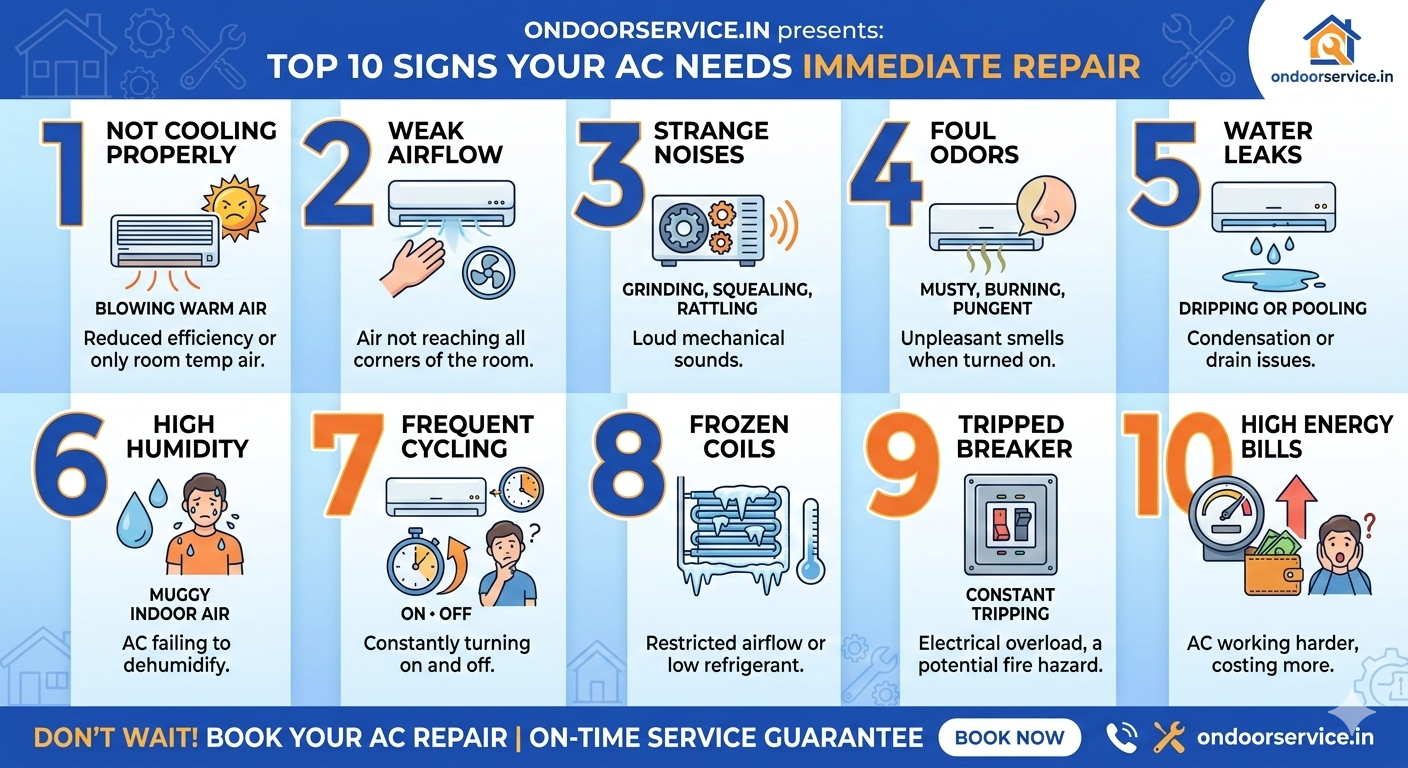
Air conditioners are complex, heavy-duty machines designed to withstand grueling summer heat, but they are not invincible. Like any massive mechanical system running continuously for months on end, parts wear down, electrical components degrade, and critical failures eventually happen. The biggest mistake homeowners make is completely ignoring the subtle warning signs until the system catastrophic fails—usually on the hottest day of the year when repairmen are fully booked.
Catching these warning signs early can literally save you thousands of rupees, drastically extending the life of your expensive appliance, and preventing the agonizing discomfort of a fully broken AC. So, how do you know when it is time to stop waiting and call in the experts? Below, we dive deep into the Top 10 undeniable signs that your AC demands immediate, professional repair from the trained technicians at Ondoor Service.
1. Blowing Warm or Hot Air
This is the most obvious, glaring sign of immediate AC trouble. You turn on the unit, set the thermostat to a brisk 18 degrees, wait 20 minutes, and the vents are still aggressively blowing warm, humid air into your living room. Before you panic, verify that your remote is actually set to "Cool" mode and not "Fan" or "Dry." If the settings are correct, blowing warm air typically indicates a critically low refrigerant gas level due to a severe copper pipe leak, or a completely failed compressor. Both of these massive issues mandate the immediate attention of a licensed technician.
2. Weak or Insufficient Airflow
If the air coming out of your vents is cold, but the actual force of the air is frustratingly weak—barely a trickle—you are experiencing an airflow crisis. This heavily restricts the AC's ability to circulate cool air throughout the bedroom. The most common, benign culprit is a completely blocked, filthy air filter that you can quickly wash yourself. However, if the filter is pristine, weak airflow points to a failing blower motor, a frozen evaporator coil blocking the passage of air, or deeply clogged internal ducting. Do not let the blower motor strain itself to death; get it checked.
3. Strange, Unsettling Noises
Your AC relies on rapidly moving fan blades, high-pressure gas pumping, and high-voltage electricity; it is never going to be completely silent. A low, steady hum is perfectly normal. However, if the unit suddenly sounds like a busy construction site, you have a severe mechanical emergency:
- Grinding: The internal motor bearings have completely shattered. Continued use will burn the motor out.
- Squealing/Screeching: A fan belt inside the blower is slipping, or the high-pressure compressor outdoor is locking up.
- Loud Banging/Rattling: A vital internal component (like a fan blade or mount) has broken completely loose and is dangerously bouncing around inside the expensive machinery.
4. Foul and Unusual Odors
Air conditioning should provide clean, refreshing, breathable air. If turning on your AC immediately fills the room with a dreadful stench, you need professional intervention. A damp, intensely musty smell (often called "dirty sock syndrome") strongly indicates that mold or mildew has taken root inside the dark, wet evaporator coils or drain pan. Breathing in mold spores is highly dangerous to your respiratory health and requires professional chemical jet-pump cleaning. Conversely, a sharp, pungent burning odor means the internal electrical wiring is visibly melting—shut off the mains power immediately to prevent a house fire.
5. Frequent and Rapid Cycling
An AC functions in cooling cycles: it kicks on to lower the temperature, then goes quiet until the room warms up again. However, if your AC powers on, runs for just 60 seconds, abruptly shuts off, and then repeats this maddening process relentlessly, it is "short-cycling." Short-cycling wears down the immensely expensive compressor at a rapid, terrifying pace. It is usually caused by heavily iced-over indoor coils, a broken thermostat sending chaotic signals, or the AC unit being far too drastically oversized (tonnage) for your tiny bedroom.
6. Unexplained High Humidity
Part of an air conditioner's basic job is to violently strip oppressive, sticky moisture out of the indoor air before cooling it. In the peak of monsoon season, you should naturally feel dry and comfortable inside. If the air in your house feels heavily stagnant, sticky, or you can visibly see condensation beading up on your glass windows, your AC is utterly failing to dehumidify the air. This often points to frozen coils or a system that desperately needs a rigorous, professional tune-up and recalibration.
7. Water Leaking Indoors
Through the physical process of cooling, your AC generates a massive amount of condensation water that safely drips outside through a PVC drain pipe. If you suddenly notice water violently dripping down your expensive bedroom wallpaper, or a puddle forming on the floor directly beneath the indoor unit, you have a major issue. In most cases, the internal drain pan has rusted through, or the primary drain line is entirely choked with a thick plug of algae and sludge. Never ignore indoor water leaks, as they will aggressively destroy your plaster, electronics, and foundational flooring.
8. Ice Buildup on the Coils or Copper Pipes
It sounds highly counterintuitive, but if you look at your AC and see thick, solid white blocks of ice forming on the silver indoor coils or the outdoor copper connection pipes, your AC is incredibly sick. Ice is a definitive symptom of severe airflow restriction (the cold air is trapped inside the machine instead of blowing into the room) or critically low refrigerant gas. The compressor will continue to push gas into the frozen block until it overheats and destroys itself under the pressure. Turn the unit off immediately, let the ice naturally melt, and call a professional diagnostician.
9. A Sudden, Massive Spike in Electricity Bills
You inherently know what your typical summer power bill looks like. If you rip open this month's electricity statement and gasp in absolute horror because the bill has arbitrarily doubled, your AC is the prime suspect. As internal parts wear down, filters blindly choke, or refrigerant inevitably leaks out, the AC loses dramatic efficiency. It physically has to run twice as long, and pull twice as many amps of electricity, to achieve the basic cooling you demand. A professional repair and chemical wash will instantly pay for itself in vastly reduced electricity consumption.
10. The AC is Simply Too Old (10+ Years)
Finally, we have to talk about pure age. If your faithful air conditioner is well over a decade old, it is rapidly approaching the end of its designed mechanical lifespan. If it requires multiple, expensive repairs every single season, uses the horribly outdated (and banned) R22 refrigerant, and continues to struggle despite professional intervention, it is time to surrender. Replacing the antique unit with a modern, ultra-efficient 5-Star Inverter AC will save you immense headaches and money in the agonizing long run.
Don't Wait Until It's Too Late
Ignoring these top 10 blatant warning signs is a guaranteed, foolproof recipe for a sudden mid-summer AC breakdown. If your air conditioner is demonstrating even one of these frightening symptoms, you need highly experienced, rapid assistance.
Ondoor Service offers premium, fully transparent, identical-day AC repair and precise gas refilling across the region. Our extensively background-checked, highly skilled technicians use absolutely genuine parts to diagnose and entirely cure your AC hardware back to pristine optimal health.
Experiencing AC Issues? Let the Experts Fix It!
We provide ultra-fast, affordable, doorstep AC repair when you desperately need it most.
Call To Book: 8586965458
Schedule Online Instantly
Comments (0)
Leave a Comment