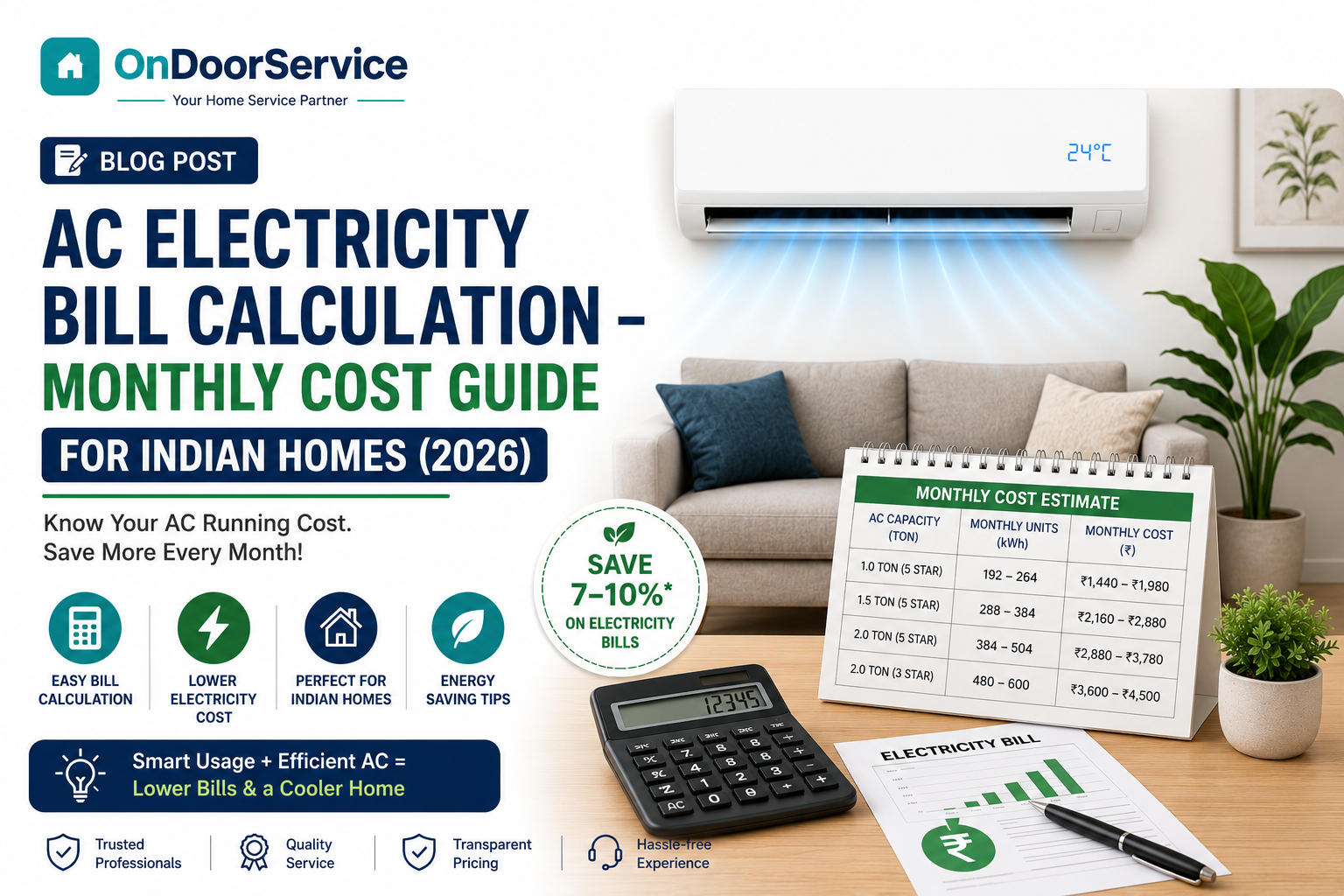
Every Indian household dreads the May electricity bill. The number is suddenly 2x or 3x your winter bill, and the culprit is almost always your air conditioner. But how much does your AC actually cost to run per hour, per day, per month? Most people have no idea — they just blame the AC and pay up. This complete AC electricity bill calculation guide for 2026 will give you the exact formula, real-world numbers for every common AC size, and 12 proven ways to cut your monthly AC bill in half — without sacrificing comfort.
By the end of this article, you'll be able to predict your summer bill within ₹100 accuracy, spot when your AC is consuming more than it should, and decide whether your old non-inverter AC is worth keeping or replacing.
📞 Book Service: 8586965458 💬 WhatsApp Now
The Simple AC Electricity Bill Formula
Let's strip away all the technical jargon. Calculating your AC's monthly electricity bill needs just three numbers, and a single multiplication. Here is the formula every Indian household should memorise:
To use this formula, you need three values:
- Power consumption (kW): Look at the back of your AC or the user manual. It will say something like "Power Input: 1500W". Divide by 1000 to get kW (so 1500W = 1.5 kW).
- Hours per day: How long your AC actually runs each day. Most Indian homes run their AC 6-10 hours daily during peak summer (May-June).
- Tariff: Your electricity cost per unit (kWh). This varies city by city, typically ₹6 to ₹10 in 2026 across India.
Worked Example
You have a 1.5 ton 5-star inverter AC (rated power input 1.0 kW) running 8 hours daily in Delhi at ₹8/unit:
That's it. No magic, no scary calculations. Now let's see real numbers for every common AC type in India.
AC Power Consumption Chart by Size and Star Rating (2026)
Use this table to find your AC's actual power consumption per hour, then apply the formula above. The numbers below are the realistic average power draw — not the manufacturer's "ideal-condition" figures.
| AC Size | Star Rating | Avg Power Draw | Units / Hour | Units / 8 Hrs Day |
|---|---|---|---|---|
| 1 Ton | 3-Star (non-inverter) | 1.0 kW | 1.0 unit | 8.0 units |
| 1 Ton | 5-Star Inverter | 0.7 kW | 0.7 unit | 5.6 units |
| 1.5 Ton | 3-Star (non-inverter) | 1.5 kW | 1.5 units | 12.0 units |
| 1.5 Ton | 5-Star Inverter | 1.0 kW | 1.0 unit | 8.0 units |
| 2 Ton | 3-Star (non-inverter) | 2.0 kW | 2.0 units | 16.0 units |
| 2 Ton | 5-Star Inverter | 1.4 kW | 1.4 units | 11.2 units |
Important note: These are average figures assuming 24°C set temperature and proper insulation. The actual draw varies — at 18°C the AC runs at full power throughout, while at 26°C the inverter compressor stays at 30-40% of rated power most of the time.
Monthly AC Bill — Real Numbers for Indian Cities
Electricity tariffs vary widely across India. Here's what running a 1.5 ton 5-star inverter AC for 8 hours daily for 30 days actually costs in different cities, based on average residential tariffs in 2026:
| City | Avg Tariff (₹/unit) | Daily Cost | Monthly Bill (1 AC) | Monthly Bill (2 ACs) |
|---|---|---|---|---|
| Delhi NCR | ₹8.0 | ₹64 | ₹1,920 | ₹3,840 |
| Mumbai | ₹11.0 | ₹88 | ₹2,640 | ₹5,280 |
| Bangalore | ₹8.5 | ₹68 | ₹2,040 | ₹4,080 |
| Hyderabad | ₹7.5 | ₹60 | ₹1,800 | ₹3,600 |
| Chennai | ₹6.5 | ₹52 | ₹1,560 | ₹3,120 |
| Kolkata | ₹9.0 | ₹72 | ₹2,160 | ₹4,320 |
| Pune | ₹10.0 | ₹80 | ₹2,400 | ₹4,800 |
| Ahmedabad | ₹7.0 | ₹56 | ₹1,680 | ₹3,360 |
| Jaipur | ₹7.5 | ₹60 | ₹1,800 | ₹3,600 |
| Lucknow | ₹7.0 | ₹56 | ₹1,680 | ₹3,360 |
| Noida / Ghaziabad | ₹7.5 | ₹60 | ₹1,800 | ₹3,600 |
| Gurgaon | ₹7.0 | ₹56 | ₹1,680 | ₹3,360 |
Bonus tip: If your bill exceeds ₹3,000 for a single 1.5-ton AC, your AC almost certainly needs servicing or has a low refrigerant problem. Genuine cooling at 24°C should never push you above the numbers in the table.
3-Star vs 5-Star — How Much Do You Really Save?
The single biggest mistake Indian homebuyers make is choosing a 3-star AC to save ₹4,000-6,000 upfront. Here's the lifetime cost comparison for a 1.5 ton AC running 8 hours daily during summer (4 months a year) over 8 years:
| Metric | 3-Star Non-Inverter | 5-Star Inverter |
|---|---|---|
| Purchase Price | ₹35,000 | ₹42,000 (+₹7,000) |
| Power Draw | 1.5 kW/hr | 1.0 kW/hr |
| Monthly Bill (8 hrs/day) | ₹2,880 | ₹1,920 |
| Monthly Saving | — | ₹960 |
| 4-Month Summer Savings | — | ₹3,840 |
| Payback Period | — | ≈ 22 months |
| 8-Year Total Savings | — | ₹30,720 |
Verdict: A 5-star inverter AC pays back the extra cost in less than two summer seasons and delivers a net ₹23,000+ profit over its 8-year life. There's no rational reason to buy a 3-star AC in 2026 unless you use it less than 4 hours a day.
How AC Setting Affects Your Bill
Three remote-control habits silently double your bill. Once you fix these, your bill drops 25-40% overnight without spending a rupee:
1. Temperature Setting (biggest impact)
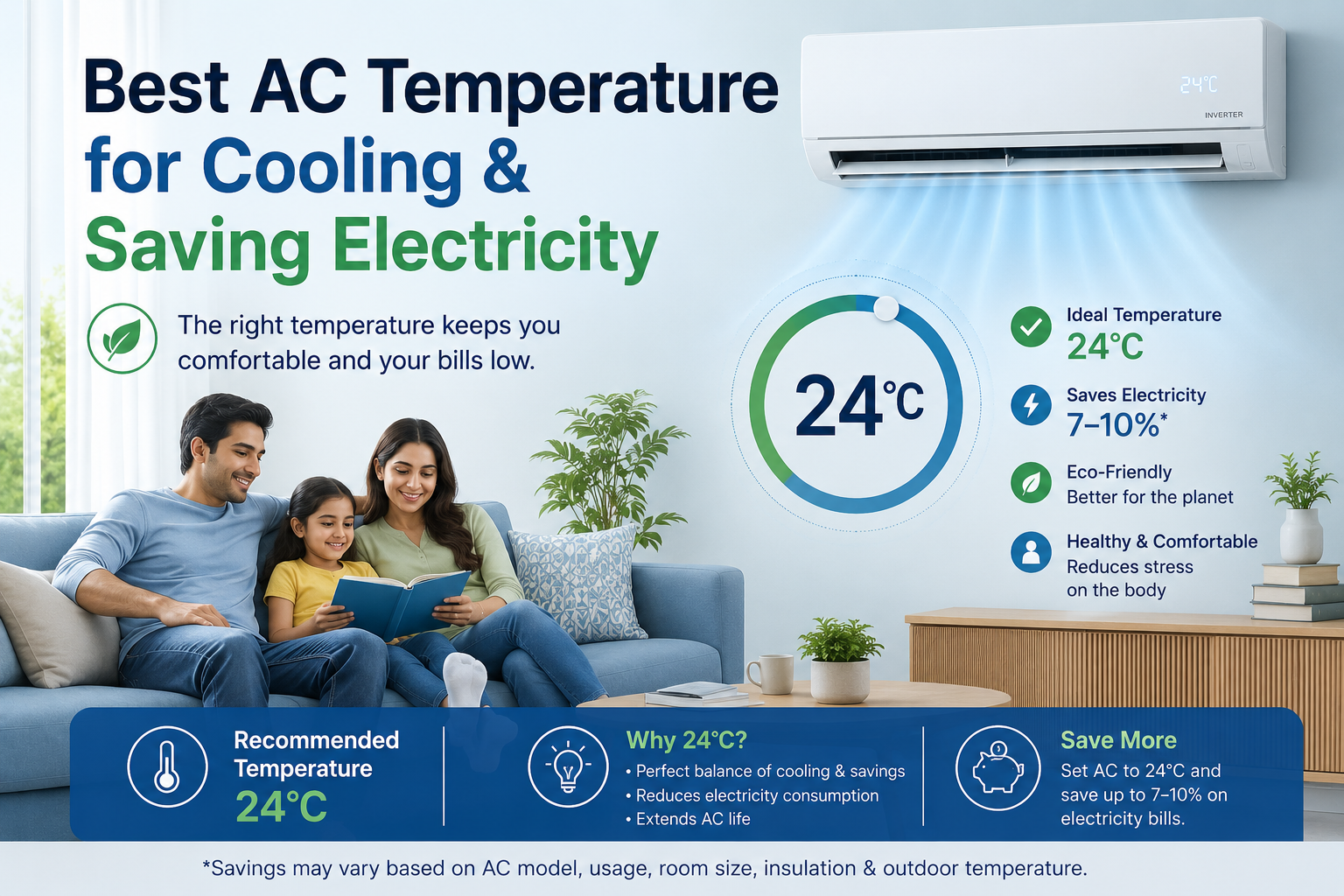
Each degree below 24°C raises consumption by 6%. Setting the AC at 18°C consumes 36% more electricity than 24°C. The room never feels colder — your bill just grows.
2. Sleep Mode
Use Sleep Mode at night (set 26°C). It increases the temperature by 1°C every hour for 2 hours, then maintains 28°C through the night. This single change saves 25% on overnight cooling without affecting sleep quality.
3. Auto Fan Mode
Manual high fan setting consumes more power than necessary. Auto fan adjusts speed based on cooling need and saves 5-8% on the total bill.
📍 Service Available Across India
An old or unserviced AC consumes 25-30% extra electricity. Get a professional service in Delhi, Mumbai, Bangalore, Hyderabad, Chennai, Kolkata, Pune, Ahmedabad, Jaipur, Lucknow, Kanpur, Nagpur, Indore, Bhopal, Patna, Chandigarh, Surat, Noida, Gurgaon, Ghaziabad and 40+ other cities.
📞 Book Now: 8586965458 💬 WhatsApp Booking12 Proven Ways to Reduce Your AC Electricity Bill
- Set the AC at 24°C — saves up to 24% compared to 18°C, with zero loss of comfort.
- Use Sleep Mode at night — saves 25% on overnight running.
- Run a ceiling fan along with the AC — circulates cool air. Adds only ₹15-20/month, lets you raise the AC temperature by 2°C.
- Clean the air filter monthly — clogged filters cut cooling efficiency by 20-30% and raise consumption proportionally.
- Get the AC serviced twice a year — pre-summer and post-summer. Service typically pays back in 2-3 months through electricity savings.
- Block direct sunlight — thick blackout curtains on west-facing windows reduce heat load by 20%, especially in Delhi, Jaipur, Ahmedabad, Surat, Kanpur.
- Seal door and window gaps — even a small gap leaks 30% of cooled air. Use weather strips.
- Switch off heat-producing appliances — TV, laptop, oven, incandescent bulbs all add load.
- Use a voltage stabilizer — low voltage forces the compressor to draw more current. A 4 kVA stabilizer protects efficiency.
- Position the outdoor unit smartly — shaded location with 1+ foot clearance. Direct sunlight on outdoor unit reduces efficiency by 15%.
- Don't switch the AC on/off repeatedly — start-up current is 3-5x running current. Inverter ACs especially are designed for continuous operation.
- Upgrade to 5-star inverter if your AC is 7+ years old — old non-inverter ACs typically consume 50% more than modern 5-star inverters. The savings often pay for the new AC within 2-3 summers.
How to Spot an Inefficient AC
If your monthly bill is significantly higher than the chart above, your AC is consuming more than it should. Here are the warning signs:
- 🔍 Bill 30%+ higher than the chart at the same hours of usage
- 🔍 AC takes more than 20 minutes to cool a properly sized room
- 🔍 Compressor never seems to stop even hours after the room is cool
- 🔍 Outdoor unit gets unusually hot or makes louder noise than before
- 🔍 Indoor unit blows lukewarm air for first 5+ minutes after starting
- 🔍 Visible dust / dirt on filters or coils
Any one of these means you can cut 20-40% off your bill simply with a service or a gas refill.
Inverter vs Non-Inverter — The Bill Difference
People often ask which one really saves more on the electricity bill. Here are the actual numbers for the same 1.5 ton AC running 8 hours daily for 30 days at ₹8/unit:
| Type | Power Draw | Monthly Bill | Annual Cost (4 months) |
|---|---|---|---|
| 3-star Non-Inverter | 1.5 kW | ₹2,880 | ₹11,520 |
| 4-star Non-Inverter | 1.3 kW | ₹2,496 | ₹9,984 |
| 3-star Inverter | 1.2 kW | ₹2,304 | ₹9,216 |
| 5-star Inverter ⭐ | 1.0 kW | ₹1,920 | ₹7,680 |
The annual difference between a 3-star non-inverter and a 5-star inverter is ₹3,840 per AC. For a household running 2 ACs, that's ₹7,680 saved every year.
Frequently Asked Questions (FAQ)
Q1. How do I calculate my AC's electricity bill?
Use the simple formula: Monthly Bill = Power (kW) × Hours/Day × 30 × Tariff (₹/unit). For example, a 1.5-ton 5-star inverter AC (1.0 kW) running 8 hours daily in Delhi (₹8/unit) costs: 1.0 × 8 × 30 × 8 = ₹1,920 per month.
Q2. How many units does a 1.5 ton AC consume per hour?
A 5-star inverter 1.5 ton AC consumes about 1.0 unit per hour at 24°C. A 3-star non-inverter 1.5 ton AC consumes about 1.5 units per hour. The exact number depends on temperature setting, room size, and outside temperature.
Q3. How much does a 1.5 ton AC cost per month in India?
Running an 8 hours/day during peak summer at 24°C, a 5-star inverter 1.5 ton AC costs roughly ₹1,500-2,500 per month depending on your city's electricity tariff. Mumbai is highest (₹2,640), Chennai is lowest (₹1,560). A 3-star non-inverter version costs 50% more.
Q4. Why is my AC bill so high suddenly?
Three most common reasons: (1) Temperature set too low (running at 18°C-20°C instead of 24°C), (2) AC needs servicing — clogged filter or low refrigerant gas can raise consumption by 30%, (3) Outside temperature is significantly higher than usual, increasing the cooling load. Try cleaning the filter and setting the AC to 24°C first; if the bill stays high, book a professional service.
Q5. Does running the AC continuously cost more than switching it on and off?
For inverter ACs, continuous running at 24°C is actually cheaper than repeated on/off cycles. Each compressor startup draws 3-5 times the running current. Modern inverter ACs are designed to run continuously and self-regulate at low power.
Q6. Is it better to buy a 5-star AC or a 3-star AC?
For anyone using the AC more than 4 hours a day, the 5-star inverter is always the better choice. The extra ₹6,000-7,000 upfront cost recovers in less than 2 summer seasons through electricity savings, and you'll save ₹25,000+ over the AC's full 8-10 year life.
Q7. Does cleaning my AC filter really reduce the electricity bill?
Yes, dramatically. A clogged filter reduces airflow by 30-40% and forces the compressor to work overtime. Cleaning the filter monthly (a 10-minute DIY job) can cut your AC bill by 15-25% — easily ₹300-600 per month per AC.
Q8. Do you offer AC servicing in my city?
Yes. Same-day AC service available in Delhi, Mumbai, Bangalore, Hyderabad, Chennai, Kolkata, Pune, Ahmedabad, Jaipur, Lucknow, Kanpur, Nagpur, Indore, Bhopal, Patna, Chandigarh, Surat, Noida, Gurgaon, Ghaziabad and 40+ other cities. Certified technicians, transparent pricing, and a 90-day service warranty.
Final Thoughts: Take Control of Your Summer Bill
Your AC bill is not a mystery. Once you know the formula — Power × Hours × 30 × Tariff — you can predict your summer bill within ₹100. Use it to spot when your AC is running inefficiently, decide which size and star rating to buy, and prove to yourself that small changes (24°C setting, monthly filter cleaning, professional service) deliver thousands of rupees in real savings every year.
If your current AC bill is much higher than the chart numbers, your AC almost certainly needs a service or gas refill. Trusted by 50,000+ Indian households for fast, transparent AC servicing across 40+ cities — same-day appointments, certified technicians, and a 90-day warranty on every job.
📞 Cut Your AC Bill by 25% — Book Service Today
A serviced AC runs 25-30% more efficiently. Same-day doorstep service across 40+ Indian cities.
📞 Call Now: 8586965458 💬 WhatsApp Now

Comments (0)
Leave a Comment